
How much time does your team spend entering and verifying data before focusing on clients?
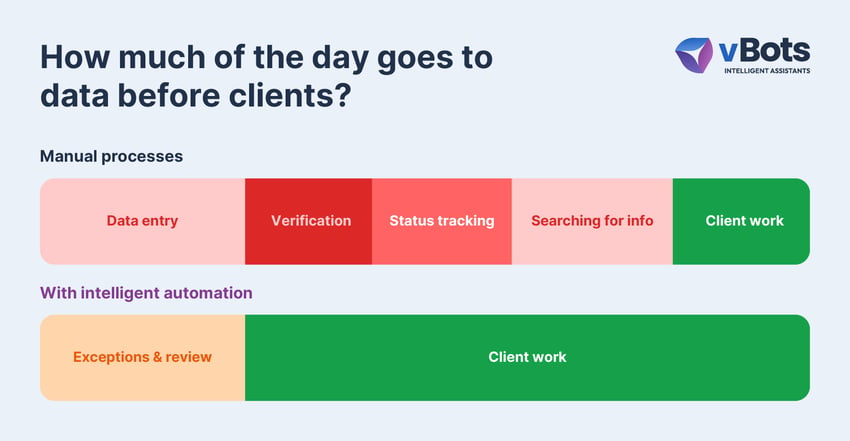
Many insurance operations still rely on employees to collect information, check its accuracy, update records, and coordinate the next steps manually. As the volume of work increases, these recurring activities can limit your agency’s capacity and make consistent processing more difficult.
Intelligent automation provides a more connected way to manage this work by completing defined process steps and directing exceptions to employees when their judgment is required. This article explains what intelligent automation means in an insurance context, how to identify a suitable starting workflow, and how to prepare that workflow within your existing technology environment.
Why Do Manual Processes Create Friction?
Insurance workflows often extend across systems designed for different purposes. The AMS holds client and policy records. Carrier portals provide documents and transaction details. Email remains a central channel for requests, notices, and supporting information.
Your employees are often responsible for connecting the information across these systems. Each transaction can require careful data entry, verification, and status tracking. As business volumes grow, the combined workload consumes substantial employee time and makes delays more difficult to identify, especially when work is managed through inbox folders, spreadsheets, or personal task lists.
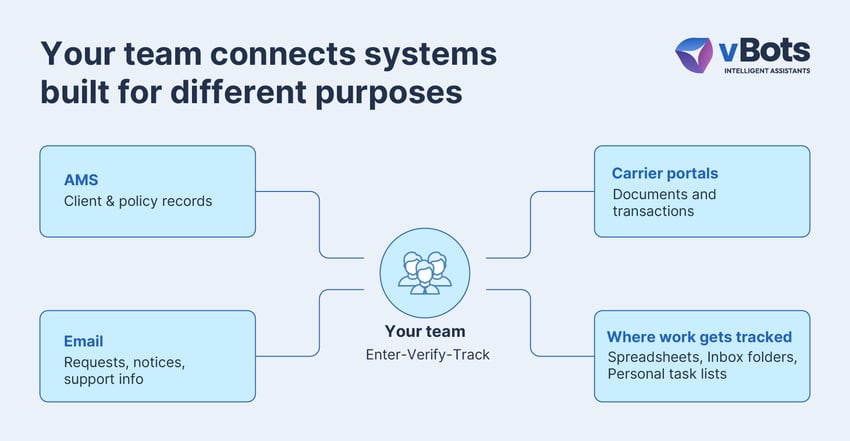
The friction comes from disconnected processes that require employees to bridge gaps repeatedly. As transaction volumes rise, these gaps place greater pressure on your team and limit your agency’s capacity to scale.
What Does “Intelligent Automation” Mean in Insurance Operations?
Intelligent automation connects the activities within an insurance workflow, reducing the repetitive work required to keep each process moving.
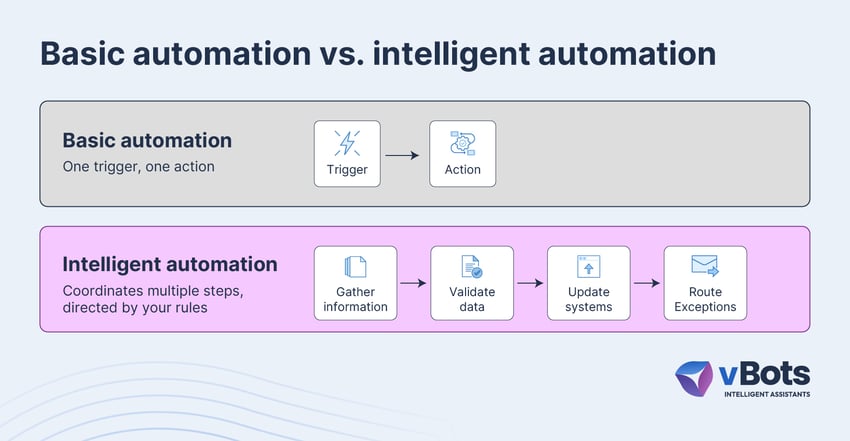
Basic automation generally performs a specific action based on a predefined trigger. Intelligent automation coordinates multiple steps, including gathering information, validating data, updating systems, and directing the workflow based on established rules.
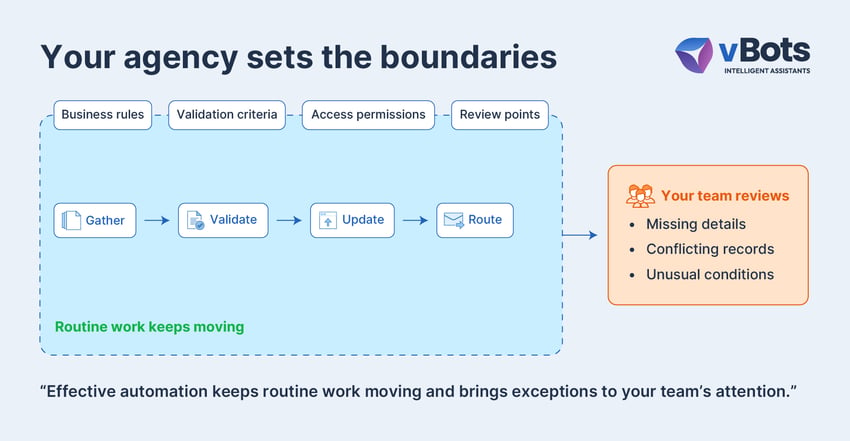
The word “intelligent” does not mean technology operates without boundaries or oversight. Your agency defines those boundaries through business rules, validation criteria, access permissions, and review points. Missing details, conflicting records, or unusual conditions are directed to your team for review.
Choosing the Right Insurance Automation Starting Point
The value of intelligent automation becomes clearer when viewed against the everyday demands on your team. Where does work slow down because employees must search for information, interpret documents, repeat data entry, or coordinate activities across systems?
Mapping one workflow from its initial trigger to completion can help answer that question. Follow how information enters your agency, how employees use it, which systems are involved, and where delays or rework emerge.
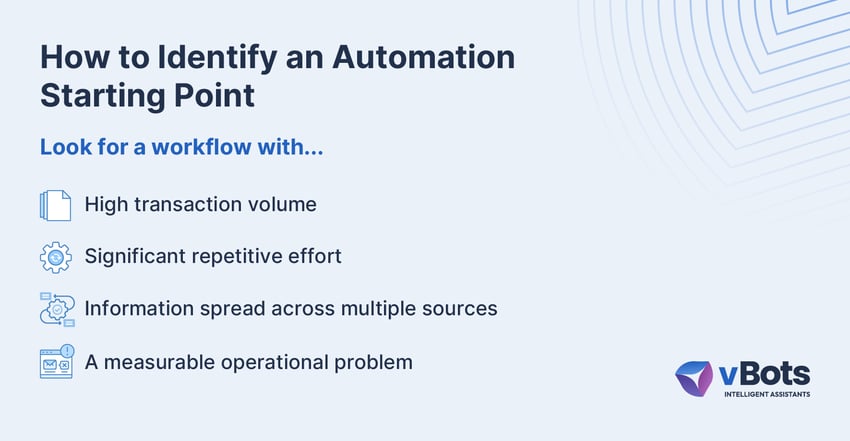
A strong insurance automation starting point typically has:
- High transaction volume
- Significant repetitive effort
- Information spread across multiple sources
- A measurable operational problem
The right starting point will vary by agency. It may be document retrieval, policy checking, renewal preparation, COI processing, cancellation notices, quote generation, or commission reconciliation.
The best choice is a workflow where intelligent automation can improve how information is processed and work progresses, while keeping your team engaged in decisions that require insurance expertise.
“Your first automation opportunity may already be hiding in the work your team repeats every day.”
Preparing the Workflow for Intelligent Automation
Once you have selected a starting workflow, the next step is to define how intelligent automation should support it. This requires a clear view of the information involved, the points where work slows down, and the situations that need employee attention.
Review the workflow through practical questions:
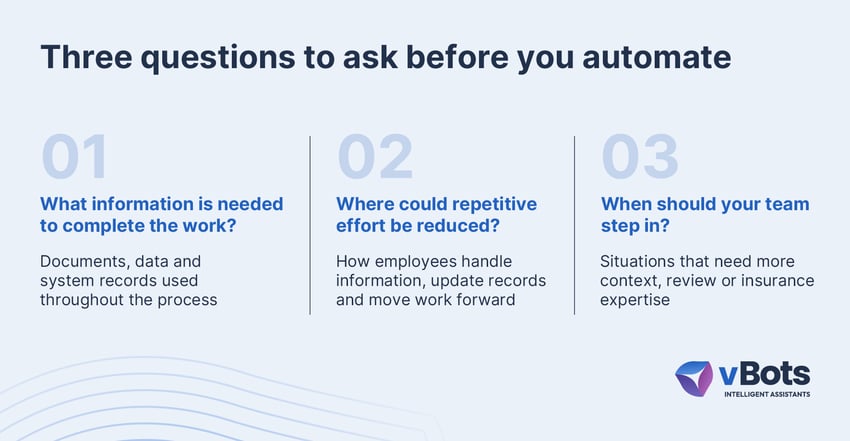
These answers help establish the role intelligent automation will play while keeping human judgment central to the process.
Moving Toward Intelligent Insurance Operations
Moving from manual processes to intelligent automation begins with a well-chosen workflow. That starting point allows your agency to improve how information moves through the operation while preserving employee involvement where expertise is required.
The outcomes from one workflow can guide what comes next. Your agency can refine its approach, strengthen its controls, and identify other areas where repeated processing is limiting capacity.
The question worth asking is:
Which workflow would your team gladly stop processing the same way tomorrow?
vBots helps insurance agencies explore that question and identify where intelligent automation can make a meaningful operational difference.
Catalyit Subscriber Offer

No Comments Yet
Let us know what you think