
Independent insurance agencies track revenue per employee, retention, premium volume, and policies per account manager.
Those metrics matter, but they do not show agency leaders where time and money are being lost.
A more actionable metric is cost per Transaction.
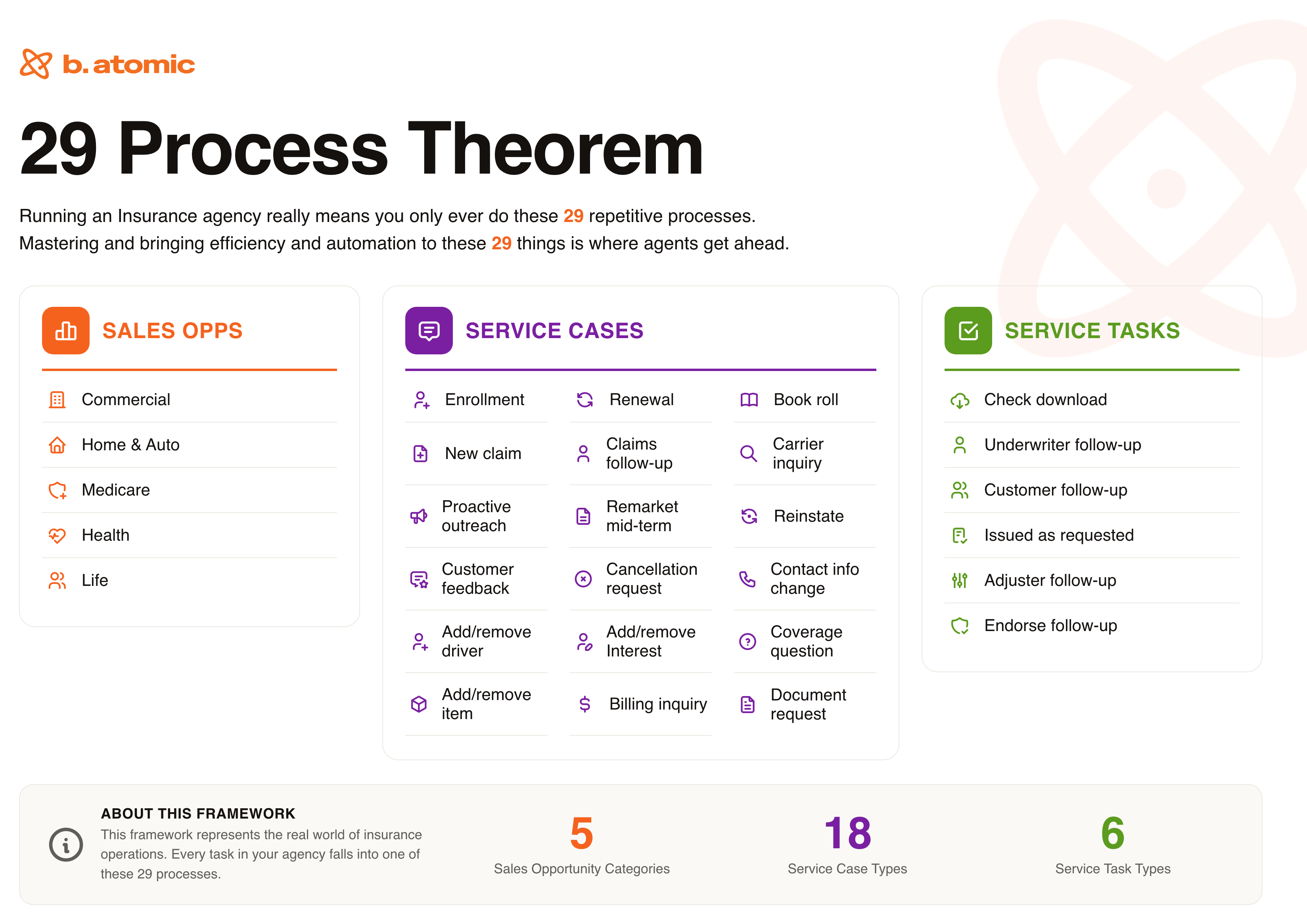
Cost per Transaction measures how much your agency spends to complete a specific activity, such as an endorsement, renewal, billing inquiry, cancellation, claim, or remarket.
By understanding this number, agencies can make better decisions about staffing, workflows, automation, outsourcing, and technology.
What Is Cost Per Transaction in an Insurance Agency?
Cost per Transaction is the estimated cost of completing one agency activity.
A simple formula is:
Cost Per Transaction = Total Cost of Completing the Work ÷ Number of Transactions Completed
For example, if an agency spends $200,000 annually on service work and completes 10,000 service transactions, its average cost per Transaction is $20.
The calculation can also be applied to individual transaction types, including:
- Policy changes
- Endorsements
- Renewals
- Midterm remarkets
- Billing questions
- Reinstatements
- Cancellations
- Claims
- Carrier follow-up
The goal is not simply to calculate one average. It is to identify which activities happen most often, cost the most, and create the greatest operational burden.
Why Does Cost Per Transaction Matter?
Cost per Transaction helps agencies understand what is happening beneath high-level performance metrics.
Retention may tell you that customers are leaving, but it does not explain which processes are causing frustration.
Revenue per employee may show productivity, but it does not reveal whether highly paid employees are spending too much time on repetitive administrative work.
Cost per Transaction makes those problems visible.
It allows agency leaders to answer questions such as:
- Which transactions consume the most staff time?
- Which activities happen most frequently?
- Are experienced employees performing low-value work?
- Which workflows should be standardized?
- Where could automation create measurable savings?
- Is a technology investment likely to produce a return?
Why Traditional Agency Metrics Are Not Enough
Most agency metrics measure outcomes.
Cost per Transaction helps diagnose the activities producing those outcomes.
For example:
- Retention shows whether customers stayed.
- Cost per Transaction shows whether service delays, inconsistent workflows, or excessive handoffs may be affecting the customer experience.
- Revenue per employee shows financial output.
- Cost per Transaction shows how efficiently employees are completing the work behind that revenue.
- Premium volume shows agency size.
- Cost per Transaction shows whether the agency is becoming more efficient as it grows.
Traditional metrics remain useful, but they become more actionable when paired with operational data.
Why Agency Operating Costs Are Increasing
Independent agencies face pressure from both sides of the income statement.
Compensation and profit-sharing opportunities may be under pressure while operating expenses continue to rise.
Common cost drivers include:
- Higher employee compensation
- Increasing software subscription costs
- Carrier-specific forms and workflows
- Additional underwriting requirements
- More follow-up activities
- Manual rekeying between systems
- Complex renewal and remarketing processes
Agencies cannot control every carrier requirement or market condition.
They can control how work is assigned, processed, and supported by technology.
How Do You Calculate Cost Per Transaction?
Begin with the data already available in your agency management system.
Review activities, tasks, workflows, or suspenses and identify the work your team completes most often.
For each transaction type, estimate:
- Annual volume: How many times does this activity happen each year?
- Time required: How long does one Transaction take?
- Labor cost: What is the hourly cost of the employee completing it?
- Additional costs: Does the Transaction require software, outsourcing, or management oversight?
A basic labor calculation is:
Employee Hourly Cost × Time Per Transaction = Labor Cost Per Transaction
For example, if an employee’s fully loaded cost is $40 per hour and a task requires 30 minutes, the estimated labor cost is $20 per Transaction.
Multiply that number by annual volume to estimate the total operational impact.
Which Transactions Should Agencies Analyze First?
Start with transactions that are both frequent and expensive.
A frustrating task that happens five times per year may not justify major process changes.
A task that happens 5,000 times per year deserves attention, even if each individual Transaction appears small.
High-priority areas often include:
- Vehicle changes
- Coverage additions or removals
- Endorsements
- Billing inquiries
- Renewal reviews
- Midterm remarkets
- Carrier follow-up
- Claims support
- Reinstatements
- Cancellations
Small improvements become meaningful when multiplied across hundreds or thousands of transactions.
Should People, Process, or Technology handle a Transaction?
Once a high-cost transaction is identified, determine whether the best solution involves people, process, or technology.
People
Keep work with experienced employees when it requires:
- Judgment
- Coverage expertise
- Relationship building
- Claims advocacy
- Complex client communication
- Risk analysis
The objective is not to remove people from service. It is to protect their time for work that requires human expertise.
Process
Improve the workflow when the problem is caused by:
- Inconsistent procedures
- Unclear ownership
- Repeated handoffs
- Missing information
- Poor documentation
- Duplicate work
A better process may solve the problem without purchasing new technology.
Technology
Consider technology when a transaction:
- Happens frequently
- Follows predictable steps
- Requires repetitive data entry
- Creates delays
- Consumes valuable employee time
- Can be completed at a lower cost through automation or integration
Technology should solve a clearly defined operational problem, not become another disconnected tool in the agency’s tech stack.
How Does Cost Per Transaction Improve Technology Decisions?
Many agencies evaluate software before defining the problem they need to solve.
Cost-per-transaction analysis reverses that process.
Before purchasing technology, ask:
- What specific Transaction are we improving?
- How often does it occur?
- What does it currently cost?
- How much time could the technology save?
- What would the new cost per Transaction be?
- How quickly would the agency recover its investment?
This creates a measurable business case.
Instead of asking whether a tool has impressive features, the agency can ask whether it reduces costs, improves service, or gives employees more time for valuable work.
How Can Cost Per Transaction Reduce Employee Burnout?
Employees become frustrated when workloads are unclear, repetitive work is unevenly distributed, or experienced team members spend too much time on low-value activities.
Transaction-level data helps leaders see:
- Who is handling each type of work
- How much work each person completes
- Whether workloads are balanced
- Which tasks should be reassigned
- Where employees need training or support
- Which activities should be automated
When repetitive processing is routed to the lowest-cost appropriate resource, experienced employees can focus on:
- Customer conversations
- Coverage guidance
- Claims support
- Retention
- Cross-selling
- Relationship building
That can improve job satisfaction while strengthening the customer experience.
How Does Cost Per Transaction Improve Customer Experience?
Customers do not experience your revenue-per-employee ratio.
They experience how quickly and accurately their needs are handled.
High transaction costs often signal:
- Too many handoffs
- Slow response times
- Repeated requests for information
- Manual processing
- Inconsistent communication
- Delayed carrier follow-up
Reducing unnecessary steps can make service faster and more consistent.
It also gives employees more time to communicate with customers instead of processing paperwork.
Where Should an Agency Start?
You do not need perfect data to begin.
Start with these five steps:
- Export activities, tasks, or suspenses from your agency management system.
- Group them into common transaction types.
- Identify the highest-volume activities.
- Estimate the time and labor cost for each one.
- Decide whether the best solution involves people, process, or technology.
Even an initial estimate can reveal where your agency is losing time, creating unnecessary work, or spending more than expected.
The Bottom Line
Independent agencies cannot control every commission change, carrier requirement, or rising expense.
They can gain greater control over how work gets done.
Cost per Transaction gives agency leaders a practical way to evaluate operations at the activity level.
It helps agencies:
- Identify expensive workflows
- Improve staffing decisions
- Balance employee workloads
- Evaluate technology more effectively
- Protect margins
- Reduce burnout
- Improve customer service
Revenue, retention, and premium volume tell you how your agency is performing.
Cost per Transaction helps explain why.
Frequently Asked Questions
What is a good cost per Transaction for an insurance agency?
There is no universal benchmark because costs vary by transaction type, employee compensation, agency size, workflow, and technology. The most useful starting point is to calculate your current cost and measure improvement over time.
What agency transactions are typically the most expensive?
Remarketing, renewal reviews, complex endorsements, carrier inquiries, and activities requiring repeated customer follow-up are often among the most expensive.
Can automation lower cost per Transaction?
Yes. Automation can lower costs when a transaction is frequent, repeatable, rules-based, and does not require significant judgment or relationship management.
Does cost per Transaction replace retention or revenue metrics?
No. It complements them. Retention and revenue measure outcomes, while cost per Transaction reveals the operational activity behind those results.
What data do agencies need to calculate cost per Transaction?
Agencies typically need transaction volume, estimated completion time, employee labor cost, and any software or outsourcing expenses connected to the activity.
Why should agencies measure transactions instead of employee busyness?
Busyness does not show whether employees are working on the right activities. Transaction data reveals what work is being completed, how frequently it occurs, and how much it costs.
This version is structured to improve featured-snippet potential, AI-generated answers, and visibility for searches related to agency efficiency, automation, operating costs, and technology ROI.
Advertisement

You May Also Like
These Related Stories
How Many Processes Does Your Agency Actually Run?

Solution Provider Spotlight: b atomic Helps Agencies Get Service Work Done Faster

No Comments Yet
Let us know what you think