
Twenty-six years as an independent agent has taught me to question everything. As a co-founder of an agency network, an independent agency, and now an insurtech, I've learned to challenge everything and to accept nothing as true or required until proven otherwise.
Why? Because the independent agent has become the default workhorse of the IA channel. As a result, it can feel like there are limitless processes the independent agent is asked to perform for the customer, the agency, or the carrier. The result: agencies over-employ knowledge workers for processing, and over-contract single-solution SaaS providers. The bottom line, the economics of the modern independent agency no longer support over-employing people or over-contracting software.
So what's the truth about insurance process? Is it really limitless? And how does understanding that truth let your agency rightsize its people, process, and technology?
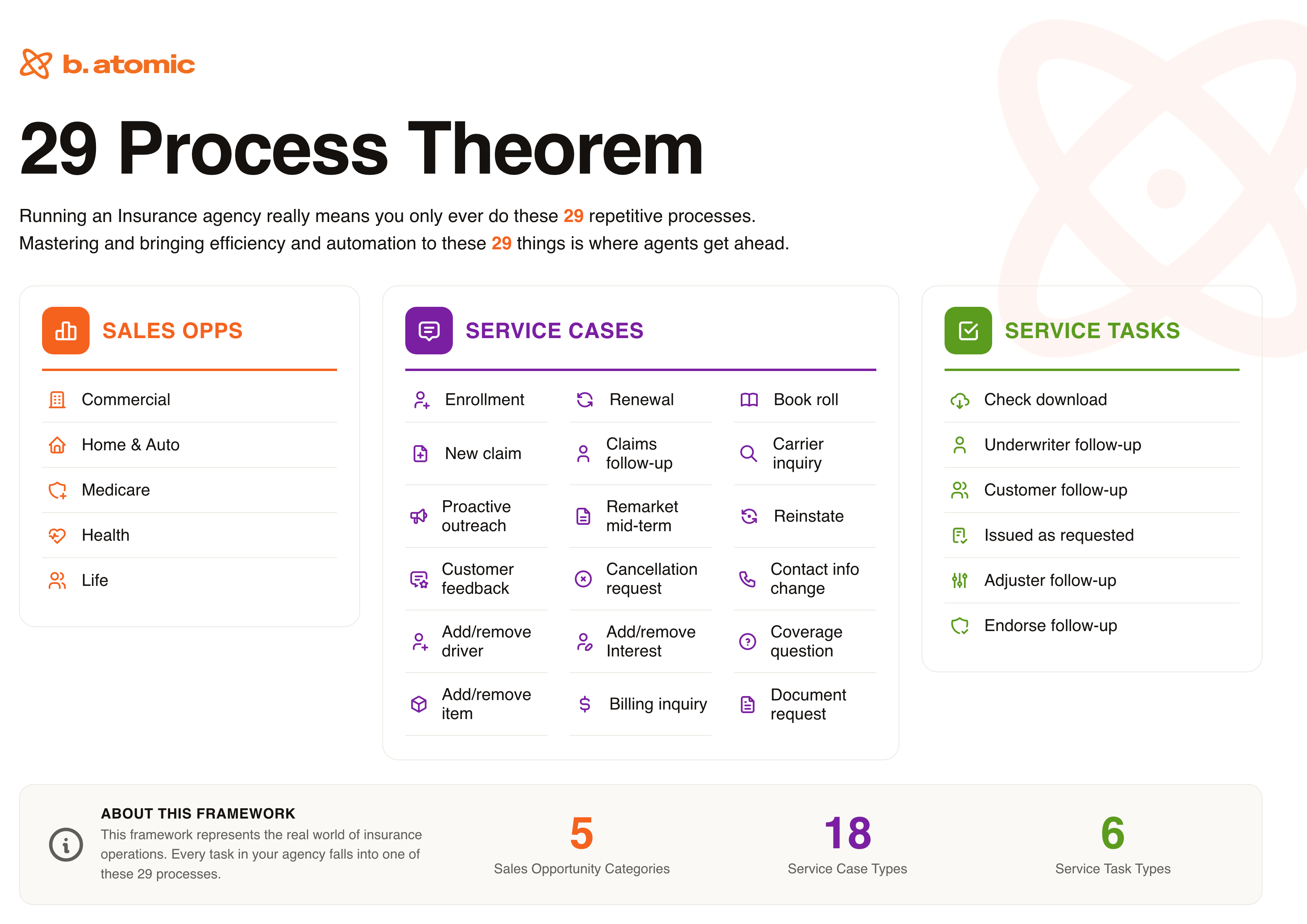
The truth is simple: the number of insurance processes happening inside your agency is finite — likely under thirty. Don't fall in love with the number itself; fall in love with the realization that it's not infinite.
Next, think about how those processes differ. Sales has five: commercial, personal, Medicare, health, and life. Service has roughly eighteen, most tied to customer requests. And five or six are simply high-volume tasks related to legacy agency-carrier communication. Sales, service, and follow-ups…that's it. Depending on an agency's focus, most won't even perform many of these.
Know your process number. Decide which ones drive customer value, and place your knowledge workers and relationship people on those. Then automate the processes that drive cost, not customer experience and margin.
Rightsizing your people around the processes that touch the customer means fewer people performing more valuable work. Placing your people there drives customer satisfaction, policy count, and retention. Meanwhile, leverage AMS APIs and third-party vendors to lower your service processing unit cost and volume.
The result? Your people get the gift of time freed to scale client value by focusing only on the high-volume work that actually impacts customers and requires real expertise. And the agency gets the gift of low-cost, high-volume pricing on the processes that drive overhead, not margin.
The modern independent agent is living in a moment where all of this is finally possible. High-cost, human-powered processes simply won't support success in today's agency economics. Know what matters most: unit type, unit cost, and unit volume. And spend your time scaling margins — not people and software.
Written by Seth Zaremba, CEO, b atomic
Advertisement


Your Data May Be Safe Today: 10 Things That Will Keep It That Way

Building a Cybersecurity Culture in Your Agency

No Comments Yet
Let us know what you think