
Choosing the right level of AI for your agency
The question isn't whether your agency should use AI anymore. It's which kind, where, and how much.
A year or two ago, most of us met AI as a writing tool. You asked a question and got an email or a summary back. Then it started working beside us, suggesting the next step and drafting work for us to review. Now it can take action: plan and run multi-step work across your systems, checking in with a person at the points that matter.
That last shift is where most of the confusion lives. So let's define the terms, then build a simple way to decide which work stays with your people, which gets AI help, and which you can hand off.
Chatbots answer. Copilots assist. AI agents act.
The easiest way to see the difference is one job done three ways: a certificate request.
|
|
What it does |
Who drives |
Certificate request example |
|
Chatbot (AI assistant) |
Answers when you ask |
You do all the work |
"How do I issue a COI for this insured?" |
|
Copilot |
Works beside you in a task |
You accept each step |
Drafts the reply to the insured's email for your CSR to edit and send |
|
AI agent |
Owns a multi-step outcome |
It plans the steps and checks in for approval |
Reads the request, pulls the policy, prepares the COI, and queues it for approval |
None of these is "best." Each fits different work, and the rest of this post is about matching them.
Why this is different from the automation you've tried
Until about a year ago, automation was linear. You mapped every step: if this happens, do that. When something didn't fit the script, it stalled.
Today's AI works from outcomes. You describe the result you want, and it builds the steps from your SOPs. It adapts when a request comes in worded a new way.
Example: You say, "Send me today's pending cancellations with next steps." The AI builds the routine, pulls the pending cancellations, sorts them, and delivers the report to your inbox. No workflow builder required.
That's what makes AI agents possible. It's also why oversight matters more than ever. More on that below.
Match the level of AI to the work
Two questions decide where a workflow belongs:
- How repetitive is it? Occasional or constant?
- What does a mistake cost? Low or high?
- Is it built for insurance, or generic? Generic AI doesn't know carrier appetites, ACORD forms, or how an agency runs.
- Does it work with your current systems? You shouldn't have to switch platforms to get value.
- Can it learn your SOPs and agency rules? Your way of doing things, not a template.
- Where does a person approve the work? If a vendor can't answer clearly, keep looking.
- What's live now, and what's coming? Ask them to show you, not tell you.
- Pick one or two high-volume workflows.
- Write down how your team does them now.
- Clean up incomplete records.
- Decide who approves what.
- Name one owner to track results.
- Which workflow takes the most time each week?
- Where does it slow down, stall, or get re-keyed?
- Which level fits: human-led, AI-assisted, or an AI agent?
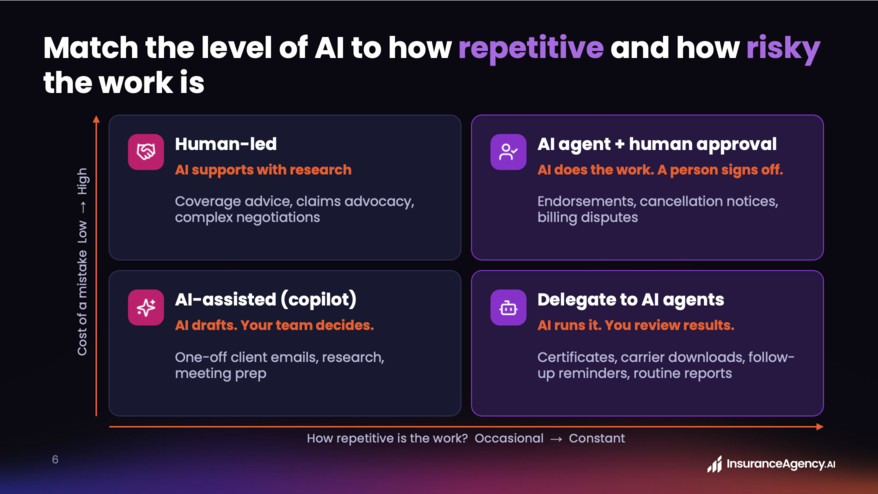
Where work belongs · repetitiveness × cost of a mistake
Agencies get the most time back in the bottom-right box. Two more questions help with the gray areas: Does the work need a client relationship or judgment? And are the rules written down? If your team can't explain the steps, AI can't follow them either.
Where common agency workflows land
|
Human-led |
AI-assisted |
Delegated to AI agents |
|
Coverage recommendations |
Renewal comparisons and remarket ideas |
Certificate requests |
|
Claims advocacy |
Drafting client replies |
Carrier downloads and record matching |
|
Carrier and client negotiations |
Prospect research and quote prep |
Overdue task and follow-up reminders |
|
Coaching and hiring your team |
Cross-sell opportunity lists |
Late-payment reminders |
Your sort may look different. Start with how your team works today.
The point of that right-hand column isn't fewer people. It's giving your people their time back for the left-hand column, where your relationships live.
Evaluate AI on fit, not the demo
Five questions to ask any AI vendor:
Five ways to get your agency ready:
Make your SOPs your AI's instructions. Agencies that write them down move faster.
More AI doesn't mean less control
The fear I hear most: if AI takes action, who's watching it?
The answer is a review step built into the workflow. A well-designed system moves every task through a simple pipeline: To Do → In Progress → In Review → Done. In Review is where a person approves.
Look for three safeguards:
- Approval before anything sensitive goes out, like an email to an insured.
- Clarifying questions, not guesses, when a task is unclear.
- Exceptions routed to your team. Disputes and urgent items go to a CSR.
- Service Request: certificates, endorsements, and routine changes
- Customer Service: calls, email, and chat logged and routed
- Office Manager: overdue items, data checks, carrier downloads
- Account Manager: renewal prep and at-risk accounts
- Sales: lead intake, quoting, and follow-up
- Accounting: commission matching and month-end reports
- Billing: payment reminders and cancellations
You decide where the approval points sit. Start with more of them, then loosen up as trust builds.
What this looks like in practice
InsuranceAgency.AI is one example of this approach: an AI operating system built for independent agencies. It isn't an agency management system or a CRM. It works alongside the tools you already use, with a specialized AI agent for each core function:
Agencies can also build their own skills by uploading SOPs and agency documents once, so the AI follows them every time.
Start with one workflow
You don't need an AI strategy deck to get going. Pick one workflow and answer three questions:
That's your starting point. This isn't about adding another tool. It's about changing how the work gets done, so your team can spend more time on the work only people can do.
Watch our conversation with Michael Lebor from Momentum AMP.
Advertisement


The Biggest Finding in Catalyit’s 2026 State of Tech Report

Your Agency Doesn’t Have a Technology Problem. It Has an Execution Problem.
No Comments Yet
Let us know what you think